
|
| |
|
  |
|
|||||||||||||||||||||||||||||||||||||||
|
Laws
|
Members' Enquiries
and Laws Committee Decisions
|
| May 2012 - Bowls Scotland | |
|
1.4.3
|
The Scoittish Bowls Umpiring Committee sought clarification on the stamping of bowls as described below:- Law 1.4.3 describes what is a "Set of Bowls"
and Law 1.4.3.3. indicates that they must be the same "size, weight,
colour, bias, serial number and engraving". These bowls are probably of such vintage that they were sold before the advent of serial numbers and, despite being tested and stamped on several occasions, still have no serial numbers on them. A recent instance has been reported that a player took such bowls to be tested and they were returned, stamped and certificated, despite having no serial numbers on them. The questions raised by this are: A) Despite being tested and stamped, are
these bowls legal to play with? |
|
LC Decision: The answers to the questions posed in the Scottish Bowls Umpiring Committee query are as follows. (A) The bowls are not 'legal to play with'. Bowls used during competitive play should comply with the requirements defined in the Laws of the Sport. The requirement for each player to play with the appropriate number of bowls from the same set is defined in law 8.1.9 and the requirement for each bowl in the set to have the same serial number is defined in law 1.4.3.3. (B) The WB Regulations for the Testing of Bowls state that a set of bowls submitted for testing can only be re-stamped and given a 'pass' certificate if it complies with the Laws of the Sport - this includes the requirement for serial numbers described above. If a tester finds that the serial number on a bowl has faded, they are required to refresh it. If they find that the serial number is either illegible or missing, they are required to put the same new serial number on each bowl. Testers are aware of the Regulations. Any failure to meet the requirements for serial numbers, therefore, can be attributed to the occasional 'oversight' by the tester during the testing process. If an owner has recently had a set of bowls returned by a tester accompanied by a 'pass' certificate when the bowls do not have a legible serial number on them, they should return them to the tester to have the serial number added. (C) There is no need for WB to issue to testers a set of numbers for use when bowls submitted for testing do not have a serial number. Testers already have their own form of numbers for use in these circumstances (for example, one tester uses a letter followed by the last 4 digits of the certificate number). |
|
|
47.1
|
March 2012 - USA LBA In a pairs match, the skips and leads change
ends and Skip A plays first. His bowl does not disturb the head
and comes to rest very close to the jack and is now shot bowl.
Then Skip B bowls, also causing no head disturbance. Then Skip
B realises he should have bowled first. You're brought in as umpire.
How would you resolve the situation? A third umpire might rule that law 47.4.2 is the applicable law inasmuch as it clearly describes the actual situation that occurred. But the solution indicates that Skip B will lose the right to play his first bowl of the end, resulting in Skip A rolling four bowls and Skip B rolling only three. Some feel that this is unfair because Skip A was the first to roll out of turn. |
|
LC Decision:
In the US query, it is suggested that law 47.4.2 is 'the proper law' to deal with the situation described. Law 47.4 deals with situations in which a player fails to play a bowl (in previous editions of the Laws it was called 'Omitting to Play'). Law 47.4.1 deals the situation in which a player fails to play a bowl before the result of the end is decided. Law 47.4.2 deals with the situation in which both teams play a bowl before it is noticed that another player has failed to play a bowl - this law is intended to cover situations such as in a Fours game when the two Thirds play their first bowls before they notice that one of the Seconds has not played one of their bowls. The operative phrase in this law is 'failed to play'. The inclusion of the phrase 'in the proper order' in law 47.4.2 is a throw-back to earlier editions of the Laws where its inclusion was no doubt intended to clarify the situation being dealt with. It would appear that its retention in the current law is now leading to the interpretation that the law deals with playing out of turn. This interpretation is not correct - the law deals with a situation in which a player has not played a bowl and not with a situation in which a player has played a bowl but played it in the wrong order. Applying this law in the case of the US query, therefore, would be incorrect. (in the light of this it may be appropriate for the LC to consider deleting the phrase in future editions.)
|
|
|
12
|
June 2011 - Bowls England: Bowls England requested clarification on the law for drawing the rinks of play. Their concern was "It seems as though many people are not offering the away team the available rinks to make a draw and the home team is choosing the rinks which suit their players." |
|
LC Decision: The Oxford Dictionary definition of 'draw' is "an act of selecting names randomly to decide winners in a lottery, opponents in a sporting contest, etc.". In the context of law 12.1, it would read "an act of selecting rink numbers and opponents randomly to decide opponents in a sporting contest". It follows that, for any scheduled event, there should be sufficient rinks made available for a draw to take place. Therefore, for a single game scheduled at a club, more than one rink should be made available for the draw and for competitions involving more than one rink of play (e.g. inter-county or inter-district competitions comprising a Side of three or four disciplines) the minimum number of rinks required should be made available. Rinks cannot be allocated to individual games or disciplines in advance. The rink numbers available should preferably be consecutive (e.g.. rinks 1,2,3 and 4 or rinks 2,3,4 and 5) and not interspersed with other games being played at the club. There are a number of ways in which the draw for rinks and opponents can take place (e.g. numbers for rinks to play on drawn from a hat by respective Skips; team representatives swapping scorecards containing the names of their skips and then shuffling and pairing the cards). The LC does not have a preferred option except to say that there should be a random draw done for rink numbers and opponents. Finally, the LC recommends that the method to be used for drawing rink numbers and opponents should be included in the Conditions of Play for the event being played. |
|
|
16.3.3. and 50.1
|
April 2011 - Bowls New Zealand: There are occasions, such as when competing teams have to travel long distances to take part in an event, in which it is impractical to continue a game at a later time or date when adverse weather conditions cause that game to be stopped. If a Controlling Body decides to exercise its powers under Law 16.3.3 - for example, by decarling that the game is null and void or declaring that the result of the game will be determined by the scores as they stood after a pre-determind number of ends have been completed - does this override the requirement to continue the game as required by Law 50.1? |
| LC Decision: If a Controlling Body decides to exercise its powers under Law 16.3.3 to deal with a situation such as that described, it should include in its Conditions of Play any regulations which it deems appropriate to resolve the situation (these regulations can differ from those described in Law 50). In such circumstances the regulations in the Conditions of Play override the requirements of Law 50. |
|
|
37.1.7
|
February 2011 - Bowls South Africa: The rationale behind the Bowls SA request was as follows:"We have received numerous complaints about the skip having to keep the score card. In the past the skip was able to delegate this duty. Under the new rules he may not do so. Many skips wear glasses to read and don't need them to play. By having to keep the card they are required to constantly put on and take off their spectacles." |
|
LC Decision: 1) The concept of a skip marking a score
card is not a new one - law 37.1.7 in the Crystal Mark Edition
required the skip of a Pairs game to keep the score card. However, it is not the LC's intention that a player suffering from a physical or mental condition be placed at a disadvantage when playing the sport. Therefore, in situations, where opponents and officials agree that a player suffering from a physical or mental condition would be placed at a disadvantage if the letter of the law was to be followed, the LC would have no objections to a suitable, pragmatic solution being introduced to deal with the situation. This would, however, need to be dealt with on a case by case basis - not by the introduction of a Domestic Regulation. |
|
|
38
|
February/March 2013 - Bowls England: |
|
LC Decision: There is nothing in the Laws prohibiting
the use of "walkie-talkies" (no definition of walkie-talkies has
been given in this inquiry nor have we sought a definition. We
note however that many Controlling Bodies ban the use of mobile
phones on the green during a game ). In our view it would be prudent for Controlling Bodies to include something along the lines of the following in their Conditions of Play - When a team is in possession of the rink, a player who has a hearing disability will be allowed to use an electronic device to communicate with another member of their team who is at the opposite end of the rink . Any such communication must be conducted in a manner which does not disturb players on neighbouring rinks. 1) The devices can only be used when the
team is in possession of the rink. |
|
|
20
|
August 2013 |
|
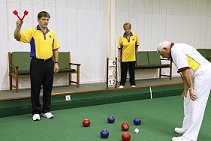
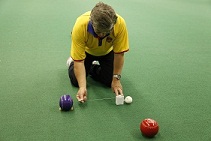
L C Decision: Bowls is an all-inclusive sport. Players come from both genders, a wide range of age groups and can have a broad range of physical and intellectual impairments. When compiling the Laws of the Sport, therefore, members of the World Bowls Laws Committee try to make sure that they do not introduce laws which would discourage anyone from taking part in the sport. They also recognise that trying to legislate for every situation which could arise (even if these could be predicted in advance) would result in a law book which would rival 'War and Peace' in thickness! The referral concerning the legality of kneeling on the green to deliver a bowl aptly illustrates the dilemma faced by the legislators. The laws do not specifically cover the situation referred. However, in principle, the Laws Committee looks favourably on any solution which allows an individual who suffers from a physical impairment to continue playing the sport - with the proviso that the solution is in line with the intent and spirit of the laws. Over the years, the Laws Committee has acknowledged that kneeling on the green to deliver a bowl offers an acceptable alternative to standing on the mat for players with certain physical impairments. The photographs below illustrate this. They show two players who represented Scotland in the Open Triples competition for players with physical disabilities that formed part of an 8-Nations Commonwealth Games Test Event held in Glasgow between 26th and 31st August 2013. Whilst the delivery positions are different both players comply with the requirement of law 20.1 that 'at the moment they deliver a jack or a bowl, the player should have all or part of one foot on or above the mat'. It should also be noted that the players protect their trousers from staining (a concern raised in the referral) by the use of either a foam kneeling pad (photograph 1) or knee protectors strapped to both knees (photograph 2)
Photograph 1 Photograph 2 [Both players have given their consent to their photographs being used by World Bowls. The photographs cannot be used for any other purpose.] |